

(Any views expressed below are the personal views of the author and should not form the basis for making investment decisions, nor be construed as a recommendation or advice to engage in investment transactions.)
Oh how quickly the winds can shift. It was just a few days ago that no one other than you all (thank you) and me were paying attention to bitcoin. It was the most apathetic period since bitcoin faded into irrelevance back in late 2018/2019. If I’m honest, while I’ve been DCA’ing over the last few weeks and telling you all how bullish I’ve been over the last few months, I was not sure where the next catalyst would come from. That’s usually how it goes, and it’s why time in the market beats trying to time the market, especially with bitcoin where missing only a handful of its best days can wipe out most of an entire year’s return.
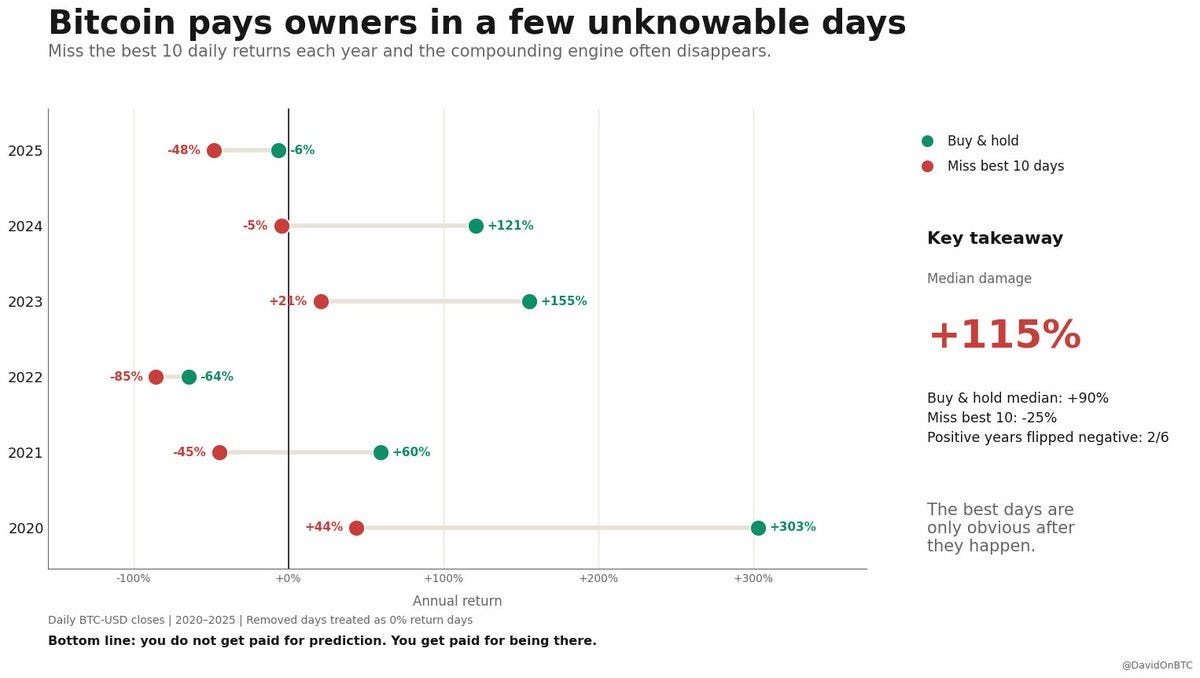
So here we were, without any excitement, and then Big Daddy Bessent showed his cards. For weeks we’ve been hearing about surging 10-year and 30-year yields and the pending doom that would come to the US and the rest of the heavily indebted world if they didn’t get under control. I’m exaggerating slightly, but only slightly. The bond market has been getting increasingly ugly and, unlike crypto, this is one market that the people in charge cannot afford to ignore.
Last week, I joked that the US was close enough to $40 trillion in debt that I might have to host the lamest countdown party of all time. Turns out, I should have started planning it and called it the ‘bitcoin bear market is over’ party instead. The number officially hit $40.047 trillion on Tuesday, up from $37.64 trillion at the end of 2025, which means the USG has added more than $2.4 trillion of debt in less than eight months.

Then, literally the next day, the Treasury announced it would at least double its buybacks of longer-dated government bonds. Starting September 9, it will increase the amount it can buy in the 10-year to 30-year part of the market from $2 billion to at least $4 billion per operation. Not up to $4 billion. At least $4 billion, with Bessent already saying yesterday that they could go bigger.
When I woke up Wednesday morning and saw the Treasury’s announcement, my first thought was yield curve control or stealth QE—and X was immediately full of the same reaction. After reading into it, these buybacks are not really QE: the Treasury is taking older bonds out of the market while continuing to issue new debt elsewhere, so the printer has not been fired up… yet.
What Bessent was trying to do was subdue the 30-year Treasury yield, which had just touched 5.34% (its highest level since 2007). Yields fell ~10 bps almost immediately, but by Thursday morning they were already ripping higher again and back around 5.23%. The rebound made the words “at least” feel a lot more important.


This is a band-aid on a gushing wound. For context, the Treasury market is worth more than $30 trillion, so this $4 billion+ is basically a rounding error. It might help liquidity in some older bonds, but it is nowhere near enough to overpower the market if investors keep demanding higher yields. Bessent saying they could go bigger only one day after the announcement gave us a pretty good idea of how this will go if the first increase does not work.
One of the key takeaways for me is that the situation must be incredibly dire if Bessent feels that intervention with all of this financial engineering is needed while the stock market is at all time highs. And with midterms coming down the pike and Trump’s approval rating in the gutter, I can’t imagine that they’re going to slow down. From my experience it’s best not to try to swim against the current.
That may explain Bessent’s answer when he was asked about the country crossing $40 trillion in debt: “We’re going to have to grow our way out of this.” It is probably the only politically acceptable answer and one we’ve discussed in these missives all year. The US is not going to cut spending enough to matter, nobody is getting elected on a promise to massively raise taxes and default is obviously not on the table.


The obvious question is what kind of growth he is talking about. Real growth would be the dream, and maybe AI produces enough productivity to help pull it off. I sincerely hope it does. The problem is that the CBO already assumes the economy will keep growing and still expects a $1.9 trillion deficit this year, a $3.1 trillion deficit by 2036 and annual net interest expense to more than double from $1 trillion to $2.1 trillion over the same period. Unless AI turns the US economy into some kind of cheat code, real growth alone is probably not getting it done.
Nominal GDP growth is some combination of real growth and inflation. If the economy produces 5% more goods and services, everyone is genuinely better off. If the same amount of stuff simply costs 5% more, GDP still rises in dollar terms and yesterday’s debt becomes easier for the government to carry. The people earning and saving those dollars are the ones quietly paying for it through lost purchasing power.
Luke Gromen has been completely on point since the start of the Iran war. His argument is that the US needs nominal GDP to grow faster than the interest rate it pays on its debt, which will almost certainly require keeping real rates significantly negative. That is how you inflate away a debt load without ever missing a payment.
This is why I think the debasement trade is back. Long-term yields reached a level the government clearly did not like and could not afford to let persist, so Treasury stepped in. The relief barely lasted a day, and Bessent was already talking about going bigger. Call it liquidity support, buybacks or financial engineering, but we now have a pretty good idea how the government will respond when long-term rates start causing enough pain.
As I write this at 6:40 on Friday morning, I have the BTC ticker on the top right and we just missed $80k. It was trading around $65,000 when I started writing this letter, meaning the newsletter has appreciated ~23% before I have even hit publish. Maybe I should have spent less time writing and more time buying.
It would be convenient to attribute the entire move to Treasury, but the White House meeting, Trump’s push for the CLARITY Act and one of the largest crypto short squeezes on record all helped. Still, bitcoin has done exactly what we have been waiting for it to do. The debt crossed $40 trillion, Treasury intervened in the bond market and capital immediately rushed toward the only major financial asset with a perfectly fixed supply.

Bitcoin does not need the dollar to collapse for this to work. It only needs governments to keep choosing more liquidity and more inflation over austerity while its own supply remains fixed at 21 million.
Last week I said I was buying while almost nobody was paying attention.
I’m still buying.
Have a great weekend!