

(Any views expressed below are the personal views of the author and should not form the basis for making investment decisions, nor be construed as a recommendation or advice to engage in investment transactions.)
Good(ish) morning!
Hope you all have been well since I last wrote. The jet lag has finally worn off so I’m back and thankfully I don’t have to look too far to find something to write about. It’s literally been a life changing month for me. Not just because I got married, or because of all of the amazing meals I had on our honeymoon, but also because I’ve come to the realization that the internet is not safe and it’s only going to get worse. The title of this week’s letter is a direct quote from our CTO who is on the bleeding edge of artificial intelligence. “Yikes” was my blank faced response.
That was earlier this week and I had been chipping away at this piece up until yesterday when I heard that Binance was hacked for billions. Great. I tried to stay on top of it well into the evening but decided that it would be best to get some sleep and see where things are at in the morning. It’s now 5am and I have to say that I’m pleasantly surprised that BTC is down only ~3% after the largest exchange hack in history.


Before I dig in, I want to double-click on Satstreet and how we’re viewing this dynamic landscape of cyber security. Firstly, we are unaffected by this hack and have no association to Binance. Secondly, we do not use hot wallets - all of our customer assets sit with qualified custodians, offline in cold storage. Thirdly, every withdrawal we process for our clients or internally is done manually with layers of oversight, permissions, and client verification. This is the way we’ve done things since day one and we believe this level of intentional friction is what’s needed in a world soon to be dominated by super intelligence.
I wrote about how we run our business a decade ago, back in July 2026…
More Human.

(Any views expressed below are the personal views of the author and should not form the basis for making investment decisions, nor be construed as a recommendation or advice to engage in investment transactions.)
Now, if you’re reading about Binance and feeling better about keeping your money in a bank, I wouldn’t get too comfortable.
The scenario I’m thinking about is an attacker using AI to get into your account and move your money before you’ve even noticed something is wrong. Imagine the research, impersonation, and persistence of a sophisticated fraud operation becoming cheap enough to deploy against thousands of people at once. The emails could be convincing. The caller could sound familiar. The request could arrive in the middle of a conversation you thought you were having with someone you trusted.
An attacker wouldn’t necessarily need to defeat the bank’s entire security system. They might find a way through a customer, an employee, or a service provider. What worries me is the possibility that AI makes finding and exploiting those openings much faster, while letting the attacker keep trying around the clock. A scam that used to require days of someone’s attention could become one of thousands running simultaneously.
And the banks are already wrestling with machines entering their customers’ accounts. Charles Schwab CEO Rick Wurster said this week that the firm is blocking outside AI agents attempting to log in on clients’ behalf. Jamie Dimon has also warned about rogue agents and the risks of letting outside systems operate inside JPMorgan customer accounts. Some of this activity is customer-authorized, so these reports aren’t evidence of a coordinated theft. But they do give you a sense of the problem financial institutions are trying to get ahead of.
Click the headlines below to read into it if you wish.


If it’s already difficult to distinguish a customer from an agent acting for them, imagine how complicated that becomes when the agent is working for someone trying to rob them.
You could go from an account security incident to a crisis of confidence very quickly. An attack wouldn’t have to reach every customer to affect everyone’s ability to access their money. And a bank doesn’t have to be insolvent for a temporary loss of access to become a serious problem for the people and businesses relying on it.
Just a reminder, this is a hypothetical scenario I’m pondering and nothing more. Banks have substantial defences and strong AI teams battling off these attacks. But I don’t think “it’s in my bank account” should end the conversation about whether your money is safe. I think we’re going to find out pretty soon what happens when the systems and people protecting that account are put under pressure they weren’t designed for.
When our CTO was explaining how AI agents could swarm banks, and how the banks would have to fight AI with AI, this is what my smooth brain was visualizing.

I appreciate that making the bullish case for Bitcoin the morning after a multibillion-dollar exchange hack might sound a little ridiculous. But despite everything I’ve just written, I actually think there’s a very bullish argument here.
First, take a look at what Coinbase’s chief security officer shared this week. His team ran 16 AI agents across five leading models for an entire week looking for issues in Bitcoin Core. They found two minor items, both responsibly disclosed.


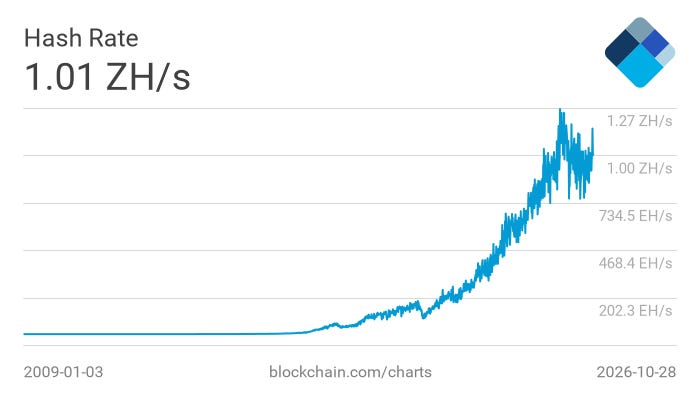
Then there’s the sheer amount of computing power securing the network. Recent estimates put Bitcoin’s hash rate around one zettahash per second. That’s roughly a billion trillion hash calculations every second. Behind that number are specialized machines, industrial power infrastructure, and electricity being consumed around the world. It’s easy to look at a chart and miss just how much physical infrastructure that represents.
An attacker trying to reliably overpower Bitcoin’s transaction history would have to compete with that mining power and sustain the effort as honest miners kept working. A more intelligent AI doesn’t automatically acquire the equipment or energy needed to do that. And even majority control of mining wouldn’t give someone the ability to spend arbitrary coins without the required signatures or force validating nodes to accept newly invented bitcoin. Mining power, cryptographic signatures, and the rules enforced by nodes do different jobs.
I was actually surprised to see a very well thought out research report from Charles Schwab analyzing the realities of an attack on bitcoin. Click here if you want to dive in.
But to be clear, none of that protects someone who hands over their keys or approves a malicious transaction. Custody still matters enormously. But when we talk about an exchange getting hacked, we should be precise about what failed. Compromising the systems around an asset is very different from defeating the network securing the asset itself.
Before I wrap up, I have to give Tether, Circle, and Binance a lot of credit.


Tether and Circle froze more than $2.3 billion in stablecoins, potentially saving Binance from a much larger bill and preventing the hackers (likely North Korea) from getting away with a much bigger loot bag.


Binance is covering the losses. Customers will be made whole. For the largest reported crypto hack in history to end without customers taking the hit would be a pretty remarkable outcome.


I see another, more important silver lining here. I suspect every exchange and custodian is now taking a very hard look at its security. An incident this expensive moves cybersecurity to the top of everyone’s priority list. If the industry uses this as a reason to strengthen its defences, crypto could emerge much better prepared for the next attack. Being forced to confront these risks in such a facemelting way, while still making customers whole, could eventually become an advantage over banks and businesses that haven’t faced the same test.
I can imagine a world where incident after incident hits Fortune 500 companies, disrupting operations, eroding trust, and destroying shareholder value. Investors may start asking questions about businesses they previously considered safe. Some of that capital could find its way into bitcoin, particularly as its network continues to demonstrate resilience while the systems around it struggle.
And cybersecurity is only one threat to those companies’ valuations. With Anthropic reportedly targeting an IPO in a few weeks, investors will soon be able to own one of the businesses threatening to eat the rest of their portfolios. I suspect plenty of portfolio managers will feel they can’t afford to sit that one out.
The All-In Podcast discussed this the other week. I wasn’t able to clip the minute or so for you, but if you click below, it starts with Ben Horowitz and Chamath discussing the point I made above.
But if Anthropic and the other frontier AI labs start slicing through business models left, right, and centre, where else do you put your money? What is the right price to pay for a company’s competitive advantage when the next model release could destroy the moat and bring costs crashing down for the same product or service? Investors will have to look harder for assets whose value can survive the very progress they’re betting on.
If AI delivers on its promise, goods and services could become dramatically cheaper and more abundant. I think that abundance will make true scarcity far more valuable.
Bitcoin’s supply is capped at 21 million under its existing rules, regardless of how productive the economy becomes.
At the valuations being discussed, investors in the leading AI companies will already be paying for extraordinary success. I’m much less convinced that Bitcoin’s role in that success is understood or priced in. That’s an opportunity I want exposure to before more people start doing the same math.
Stay safe out there and have a spooky Halloween weekend.