

(Any views expressed below are the personal views of the author and should not form the basis for making investment decisions, nor be construed as a recommendation or advice to engage in investment transactions.)
There was a time, not that long ago, when tens of millions of dollars sounded like a ridiculous amount of money. If you had $100 million, it meant you had built something generational, sold a serious company, inherited from someone important, or at least won capitalism in a way most people could never understand. A billion got you on the cover of magazines. And then, somehow, within the last couple of years, billions started to feel like a rounding error.
We have entered this weird new era where the human brain is being forced to normalize numbers that used to sound nuts. I can feel it happening to myself, which is probably not healthy. I will see someone sell a company for $700 million or watch some 28-year-old founder become worth $4 billion on paper and instead of reacting like a normal person, I’ll feel somewhat deserved. If they can do it, why can’t I? It’s a weird level of FOMO I haven’t experienced since the memecoin mania a couple of years ago which I did not participate in but saw first hand friends and folks in my network hit lottery ticket style wins seemingly everyday. But I know FOMO is a MOFO and I quickly return to reality and back to focusing on our business and bitcoin which will come back into favour at some point.
I’ve had many conversations over the last few weeks and there’s a clear hesitation to buy BTC at this $60k range. It’s a tough one because while I can see a world that BTC falls from here on sharp stock market decline, or some serious macro event, it is wise not to believe you can time the bottom or the top so “nibbling” here 50% off of all time highs seems like a great idea. Personally, if I had $1m cash that I was looking to deploy into BTC I might do something like $300k at current price, and put myself on a disciplined buying schedule which is price agnostic. Maybe $100k every other Friday at 10am after reading Mike’s newsletter haha.
This is what I did after the the FTX collapse which sent BTC to $15k and change. I had a bunch of cash and I started nibbling at $17k and then put myself on a strict bitcoin diet where I’d buy small amounts every other day at 8am. I did this until $27k and then decided to put it all in because it was clearly trending at that point.
To help contextualize where bitcoin stands in value town I’ve posted a chart below that I sometimes use to muster up the courage to hit the buy button. The Mayer Multiple compares bitcoin’s price to its 200-day moving average, so it is basically a quick way to see whether BTC is trading hot or cold versus its longer-term trend. Right now, it is sitting at 0.81 versus a long-term average of 1.28, which means bitcoin is trading below trend. Historically, bitcoin has traded at a higher Mayer Multiple than today’s level 82% of the time.
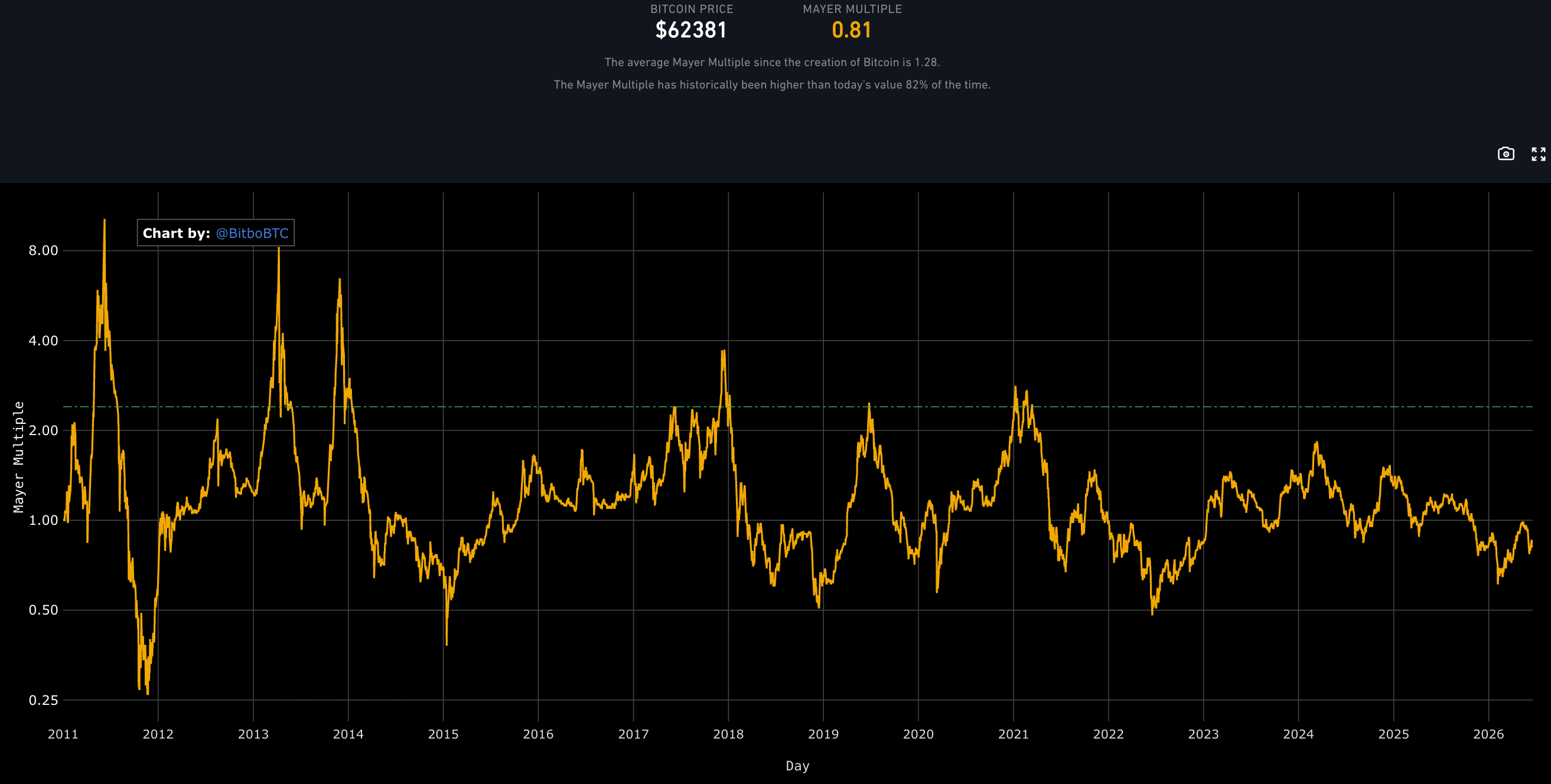
This does not mean bitcoin has to rip tomorrow, and it definitely does not mean the market owes you a clean, emotionally comfortable entry. It just means that when bitcoin feels dead, boring, and left behind, it is worth checking whether the data actually supports that depression or whether your brain is just marking BTC against whatever trade is currently melting faces. Right now, relative to its own long-term trend, this does not look like euphoria. It looks like apathy.
The thing that broke my brain last week was SpaceX (SPCX). SpaceX is being valued somewhere around twice the size of the entire Bitcoin network on revenue that is still tiny relative to the valuation. I am not mad at SpaceX or pretending I have some brilliant valuation take the market is missing. I’m a massive Elon fan. I am currently reading Liftoff, and I think SpaceX is the most impressive business story of our lifetime. If anyone deserves the trillions, it’s Elon.
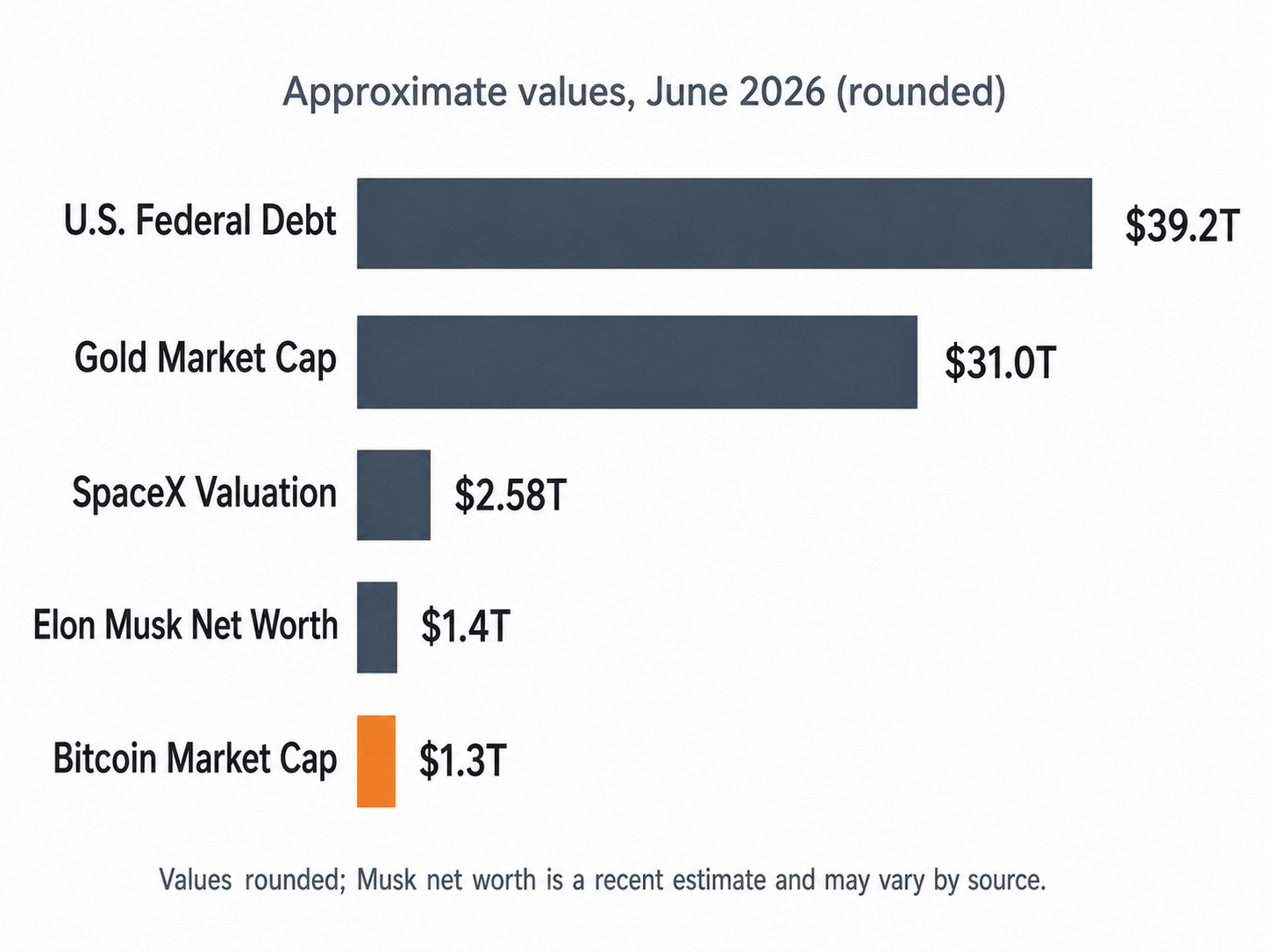

I understand why people struggle with Bitcoin here. The price action is boring, sentiment is dead, and when an asset feels like it is in a bear market while the rest of the world is chasing AI, it is easy to reduce it back to “just crypto” and move on. But my view is that this is exactly the wrong framework. If the market is willing to value SpaceX in the trillions because it sits at the intersection of rockets, satellites, defense, communications, AI infrastructure, and whatever comes next in space, then bitcoin deserves to be analyzed through the same lens of strategic importance, not through the lens of a tired crypto cycle. Bitcoin sits at the intersection of money, energy, geopolitics, settlement, scarcity, collateral, and trust, and while that may sound dramatic now, I think it is the more accurate way to understand what the asset actually is.
So on the AI hype side, I think we should separate the quality of the companies from the price people are being asked to pay. AI is real, SpaceX is real, OpenAI is real, Anthropic is real, and the infrastructure buildout behind all of this is very real. But as smart as AI is, so are the founders that built it and the investors who saw the vision early. And they are all racing to dump their equity on retail. They are smart to take that liquidity while the market is euphoric. But it is worth noticing that some of the smartest people in the room are turning private paper into public money at the exact moment retail is being invited to buy the story after it has become obvious. Billions are being raised, trillions are being created.
It’s not just these historic IPOs, tech behemoths are capitalizing on the moment.


The point of these headlines is not that AI is the new pets.com of 1999. It is that the capital cycle has clearly arrived. The companies are real, the demand is real, and the infrastructure needs are real, but when everyone from newly public giants to the biggest companies on earth is raising money at the same time, it tells you something about where we are in the cycle. The story has moved from “this technology will change everything” to “we need enormous amounts of outside capital to fund the next phase,” and that is a very different setup for investors.
This is where I think the market gets a little too casual. People hear AI and assume every dollar raised is auto bullish, but equity raises, debt financing, and insider liquidity ain’t free money. They’re claims on future cash flows being sold today, at valuations that already assume a lot of that future goes stunningly well. Maybe it does. I am not betting against the technology. But when the smartest people in the room are taking liquidity while public investors are being asked to finance the buildout, I think it is worth pausing for a second to reflect on where you’re putting your hard earned dollars.
That is the part that matters. This is not the old software cycle where the best companies could scale with beautiful margins and almost no marginal cost. AI may look like software on the surface, but underneath it is one of the biggest hard-asset booms we have ever seen. It needs chips, data centers, power, land, cooling, energy infrastructure, factories, capital markets, and grid capacity. Everyone wants to talk about models and agents, but the whole thing rests on scarce physical inputs and an enormous amount of financing.
That is why this connects back to Bitcoin for me. AI is proving that the digital world still depends on real-world scarcity, while Bitcoin is proving that the monetary world still depends on credible scarcity. You cannot fake energy forever, and you cannot fake money forever either.

When I put my macro hat on I see a bit of a problem. The US is trying to rebuild its manufacturing base in a world that is clearly, especially after the last couple of weeks, no longer unipolar. The old model was strong dollar, cheap imported goods, outsourced production, financialized everything, low inflation, cheap capital, and a consumer economy that could buy whatever it wanted while exporting dollars and financial assets in return. The problem is that this model hollowed out the industrial base and helped build China into the dominant manufacturing power on earth. Manufacturing is national security now. Energy is national security, chips are national security, shipyards are national security, and the ability to produce drones, batteries, semiconductors, and critical minerals is national security. It also doesn’t matter who wins the midterms or which side wins in 2028 — it is bipartisan.
So the US has to bring manufacturing back, and the problem is that you cannot really rebuild a manufacturing base with a dollar that remains structurally too strong. This does not mean the dollar is going to zero or that everyone needs to panic-buy canned food and start saying “fiat” too much at dinner parties. In a multipolar world where the US wants to rebuild its industrial base, compete with China, fund massive deficits, and protect the bond market, the dollar probably has to be a lot weaker than it is today.

At some point, the bond market becomes the policy. When interest costs are pushing toward trillion-dollar annual run-rates, the government’s ability to fund itself becomes the macro story.
Once you accept that, the investment world looks very different. Policymakers are trying to protect the system, keep the bond market functioning, preserve the government’s ability to fund itself, and rebuild the industrial base. When those goals conflict, the currency becomes the release valve. The real question is what happens when fiscal dominance becomes impossible to ignore. If the bond market pushes too hard, the Fed and Treasury will eventually face a choice between letting yields break the system or stepping in to keep the market functioning. I think they step in because, well, they always step in, even if they call it market functioning, liquidity support, Treasury buybacks, regulatory adjustments, or some new acronym that sounds boring enough for everyone to ignore.
Keep the system funded, keep yields from breaking the government, and let the currency absorb the pressure. That is financial repression in practice, even if nobody wants to say it out loud. The cost of that protection is almost always paid through the currency. That is wildly bullish for gold, and I think it is wildly bullish for bitcoin which has so much room as a better store of value to close the gap on its shiny big brother. It is also bullish for land, energy, infrastructure, commodities, productive real assets, and anything scarce.
Bitcoin is the digital version of that broader idea. Bitcoin is scarce, portable, divisible, global, and outside the traditional system. It can move at the speed of the internet, be self-custodied, and settle across borders without asking permission. It has a fixed supply with no central issuer. The entire point is still twenty-one million coins. No board meeting, no emergency supply increase, no policy adjustment.
And yet, relative to the world it is trying to monetize, it still feels tiny.
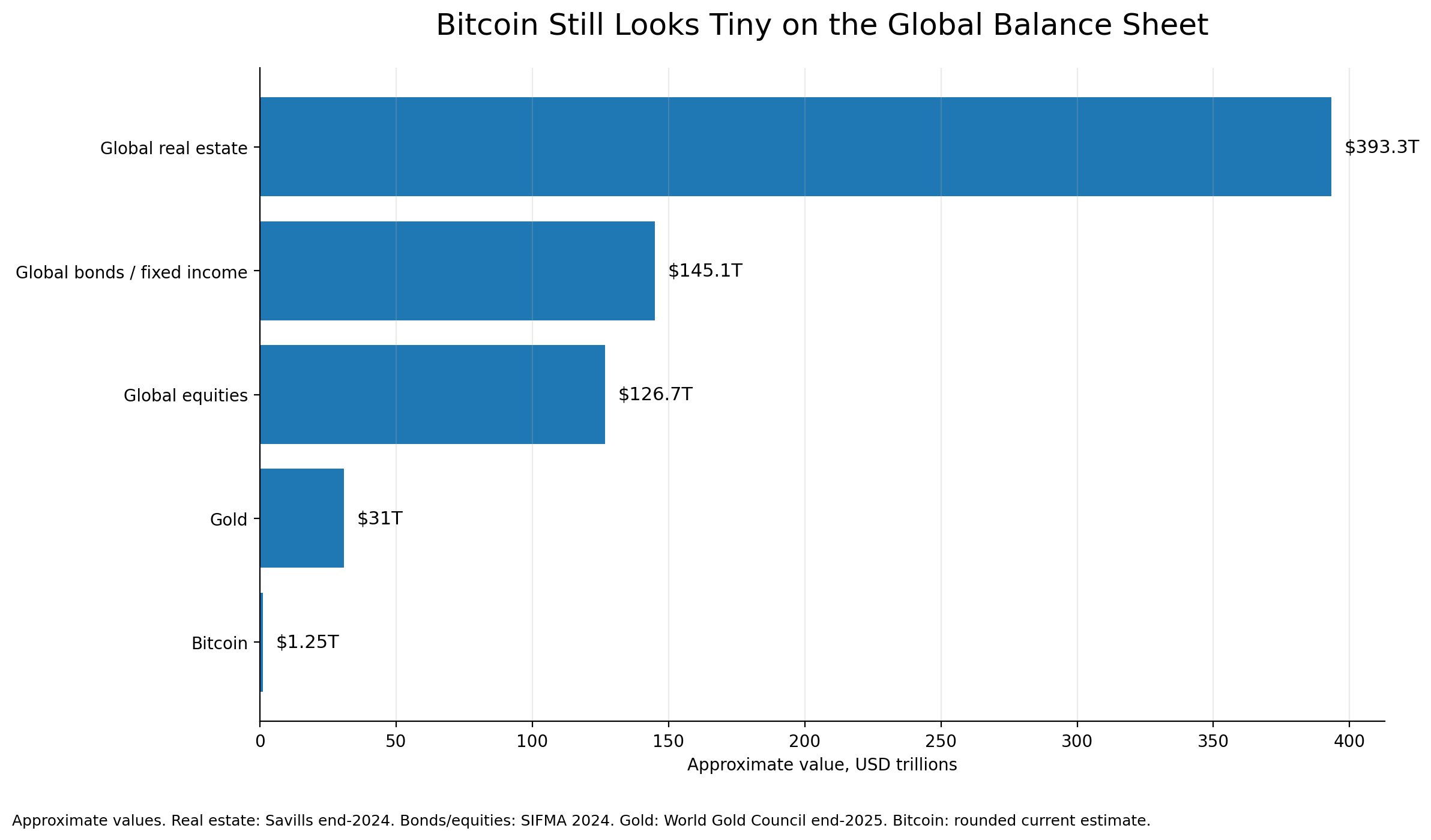
If SpaceX can be worth multiple trillions and AI companies can be worth trillions because they sit at the intersection of several future-defining markets, then bitcoin can be worth many trillions because it sits at the intersection of money, energy, geopolitics, settlement, and scarcity. This is why I think the next bitcoin run can go much higher than people expect. We’re now in the land of trillions, the tech cycle is becoming physical and capital-intensive, the US needs reindustrialization, the dollar needs to weaken, the bond market cannot be allowed to break, gold is signaling demand for neutral collateral, and bitcoin is sitting in the middle of all of it as the digital monetary asset with credible scarcity.
People will still call it expensive the whole way up because that is what they always do. They called it expensive at $100, $1,000, $10,000, $30,000, and $60,000. They will probably call it expensive at $150,000 and $250,000 too, because every new price feels insane until the denominator gets worse and the market adjusts to a new scale. The world is adjusting to new numbers everywhere else, so I do not see why Bitcoin should be the exception. Twenty-one million coins, a world drowning in debt, a weaker dollar by design, a bond market that will eventually need saving, a multipolar world searching for neutral collateral, and an AI boom reminding everyone the real world is scarce. That is the setup, and when I look at bitcoin today, I do not think the market is saying the story is over. I think the market is saying people still have not fully understood how big this can get.

Quick note before I go: thank you to everyone who came out for the inaugural Bitcoin Open. It was a massive success and honestly just a great day with a really strong group of people. We’ll definitely be doing it again next year, bigger and better.


I also added a few people from the event to this newsletter list so we can keep the conversation going. If this is not your thing, no hard feelings at all! Feel free to unsubscribe anytime. But if you’re still here, welcome to the weekly Bitcoin therapy session.
Have a great weekend!