

(Any views expressed below are the personal views of the author and should not form the basis for making investment decisions, nor be construed as a recommendation or advice to engage in investment transactions.)
Good morning!
Apologies but my promise to “write more” in 2026 is not going as planned. I went down a seemingly never-ending rabbit hole on quantum computing and the risks it presents to Bitcoin this quarter and it took a lot of thinking/writing time. Hope you enjoyed last week’s novel but if you didn’t get a chance to read it and want to read my opinion on this fascinating topic, you can check it out here: Quantum Could Be Bullish for Bitcoin.
Back to our regularly scheduled programming, for now.
We have this saying around the office that felt particularly relevant given the current state of things: no chill. It comes up often enough to be a thing because there’s always something. Rarely a dull moment. Well, the last two weeks? No chill. No chill at all.
I’m not going to pretend I have some expert military opinion on every technical reason why the Iran situation matters. On the surface, it doesn’t look great and seems like it could become a drawn-out conflict that throws a wrench into global prosperity. But what do I know.
When I’m lacking sufficient knowledge on an important macro event, I tend to radically simplify things to help me make decisions or formulate an opinion. The best way to explain that process is to relate it to how I play poker — which is not great, but I am a winning player on the margins.
There’s a saying in poker made popular by the 1998 movie Rounders: “If you can't spot the sucker in your first half hour at the table, then you are the sucker.”
When I’m at a table, I’m not trying to outplay everyone equally. I don’t use much math or statistics. I don’t look at solvers or play game theory optimal (GTO). I’m mostly a feels player.
That makes table assessment much easier for me. I’m not looking for players making technical mistakes, that’s way too hard. I’m looking for the players who can least afford to lose a big pot. The ones playing a little tighter, a little more nervous, a little more aware that one bad hand really hurts.
That’s where I can apply pressure and hopefully find an edge.
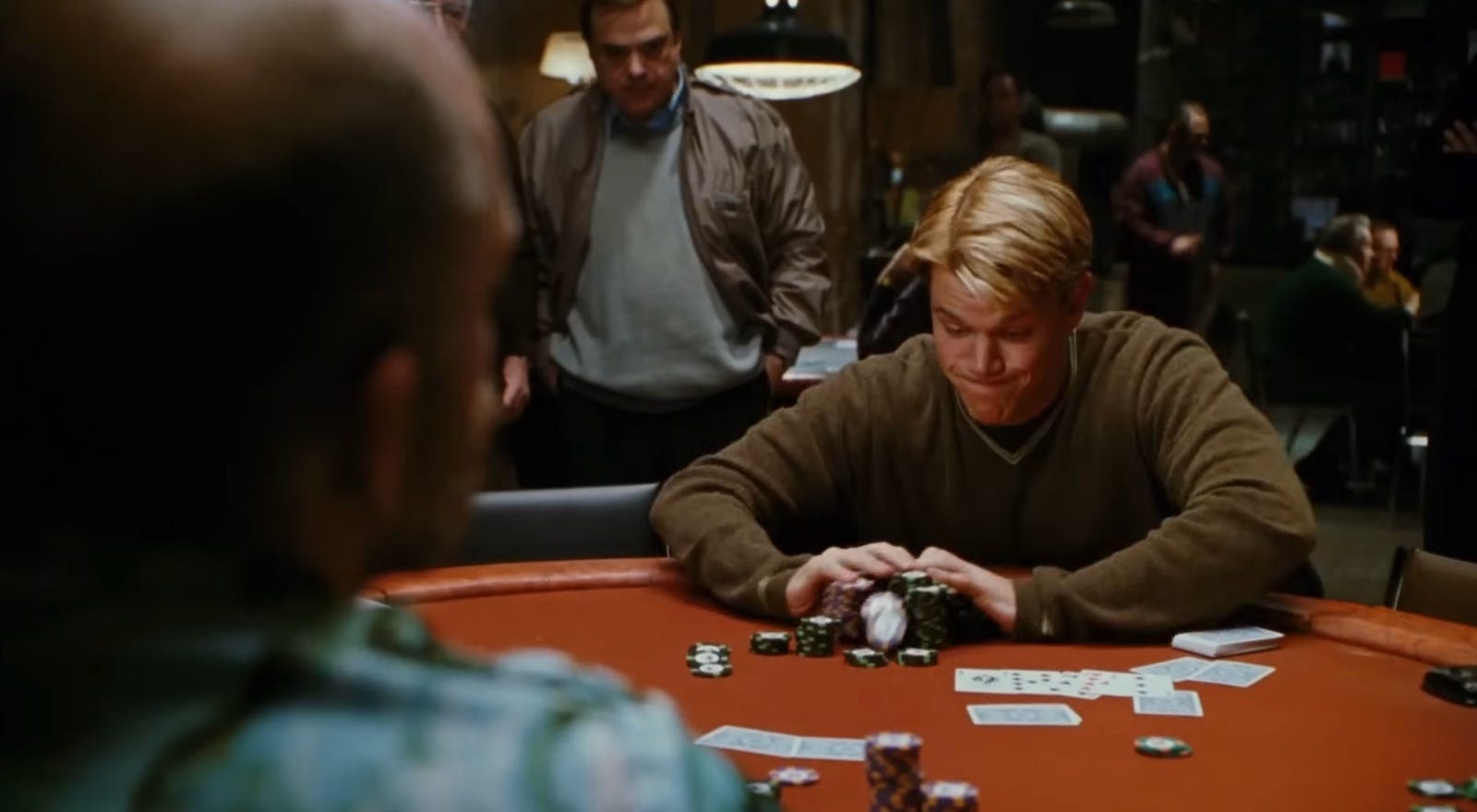
Now that you know that, you’ll have an advantage playing in our upcoming poker tournament after our inaugural golf event!

Join us on June 8th at Glen Abbey for The Bitcoin Open! We still have some early bird tickets available for our readers this week.
That’s how I think about markets and geopolitics right now.
When the world gets shaky, pressure doesn’t hit every asset, country, or “safe haven” the same way. It hits the places where confidence matters most. The places that depend on the perception of stability, prosperity, and momentum.
That’s why this moment feels bigger than just another ugly headline out of the Middle East.
You can’t spend decades turning the Gulf into a magnet for global wealth, building Dubai and Abu Dhabi from the sand into luxury hubs, financial centers, and safe havens for capital, and then have serious regional instability show up without consequences. Even if those cities remain functional and resilient, the perception of invulnerability gets tested immediately.
And once perception gets tested, capital starts asking harder questions.

That alone is enough for me to slow down, and zoom out.
Even some of the smartest macro minds in the world have spent the last year talking about leaving the West, diversifying jurisdictional risk, and moving toward places like the UAE. Ray Dalio was probably the most prominent example of that shift.
His broader thesis for why he moved his life and assets toward the UAE made sense. But this week is a reminder that no jurisdiction is bulletproof, no matter how sophisticated, wealthy, or well-positioned it looks on paper. Even investors who correctly identified the West’s decline may have underestimated how quickly geopolitical risk elsewhere can reprice the alternative.
And that brings me to gold.
There was a noticeable lack of victory laps from goldbugs this week.
War headlines. Oil ripping higher. Fear back on the menu. The kind of environment they’ve been dreaming about for years.
And yet Bitcoin has held up much better, while gold and silver have looked a lot less heroic in the moments that actually matter.

I find it fascinating that gold is known as this ultimate safe-haven asset, but when you actually need to use it, the impracticalities start shining brightest.
What do you actually do with a meaningful amount of physical gold?
The wealthiest goldbugs I know don’t even live in the same country as their gold.
Maybe I’m too much a product of the digital age, but when it comes to individual sovereignty, gold makes less and less sense to me in a world where bitcoin exists. In a pre-BTC world, sure, maybe gold was the best available answer. Maybe the price of gold would have to be so high that carrying a portable amount would finally make sense. But agh, even then. If it were that valuable, there would be so much more supply coming onto the market that it still doesn’t really work. I don’t know. I just really don’t get it.
Then I hear how hard it can be to actually sell physical gold when the market is volatile, especially in size. And then I see things like this:
I honestly don’t know what to say other than: L-M-A-O.
What good is a safe haven if you can’t easily monetize it when volatility spikes and everyone suddenly cares about liquidity?
Maybe gold just works better on a screen as a ticker than it does in your hands as treasure.
Bitcoin doesn’t have that problem.
It trades around the clock. It is global. It is portable. It is liquid. It can be moved in minutes, sold in seconds, and stored without needing a vault, a broker, or a middleman “taking a look” at it before deciding what they’d pay if they were buying in the first place.
That doesn’t mean Bitcoin is perfectly stable or that it goes up every time the world gets ugly. It doesn’t. But it increasingly feels like the one hard asset built for the kind of world we actually live in.
A world where capital moves instantly.
A world where borders matter again.
A world where confidence can crack overnight.
A world where access and liquidity matter just as much as scarcity.
Bitcoin shines when it matters.
And that, to me, is becoming harder and harder to ignore.